3L of Water: What It Means and How Long It Lasts

3 liters equals 3,000 milliliters, about 101.4 US fluid ounces, 12.7 US cups, and weighs roughly 3 kg (6.6 pounds) as water. That's a useful carrying quantity, not a universal instruction to drink that much plain water every day.
You're packing for a flight, checking tomorrow's trail forecast, or trying to fit a bottle beside your laptop. The practical question isn't just how much space the water takes up. It's whether you can carry it comfortably, reach it easily, and refill before you run out.
Think of 3L of water as both a load and a time budget. Choose the volume for your route, then choose containers that make sense when they're full and when they're empty.
3 Liters of Water in Cups, Ounces and Pounds
Three liters is 3,000 mL, approximately 101.4 US fluid ounces or 12.7 US cups. For packing purposes, the water alone weighs about 3 kg, or 6.6 pounds, before you add bottles, lids, or a hydration hose.
3 liters in common units
| Unit | Where readers meet it |
|---|---|
| 3,000 milliliters (mL) | Bottle and drink labels |
| About 101.4 US fluid ounces (fl oz) | Sports drink and water labels |
| About 12.7 US cups (8 fl oz each) | Recipes and restaurant pitchers |
| About 0.79 US gallons | Grocery store water jugs |
| Roughly 3 kg (6.6 pounds) of water | Pack scales and carry load |
Keep US in mind when comparing labels. A fluid ounce measures volume, while an ounce on a luggage scale measures weight. Mixing them up makes bottle shopping unnecessarily confusing.
For quick mental arithmetic, a liter is about 4.2 US cups or roughly 34 US fluid ounces. Six bottles labeled 500 mL reach the target; three large bottles do so only if each holds a liter. A bottle labeled 16.9 US fluid ounces is approximately 500 mL, while a US gallon jug at about 3.78 liters exceeds the target.
Store-check rule: Divide 3,000 by the bottle's capacity in milliliters, then round up if you need to carry the entire supply at once.
The carrying calculation and the drinking calculation serve different purposes. MedlinePlus's water guidance places adult total-water intake in an approximate 2.7–3.7-liter daily range, including food and beverages, rather than prescribing a particular bottle load.
Before buying containers, put your existing bottles on a kitchen scale while full. A manageable load on the kitchen counter can feel much less convenient once you add a laptop, rain shell, lunch, and an uphill walk.
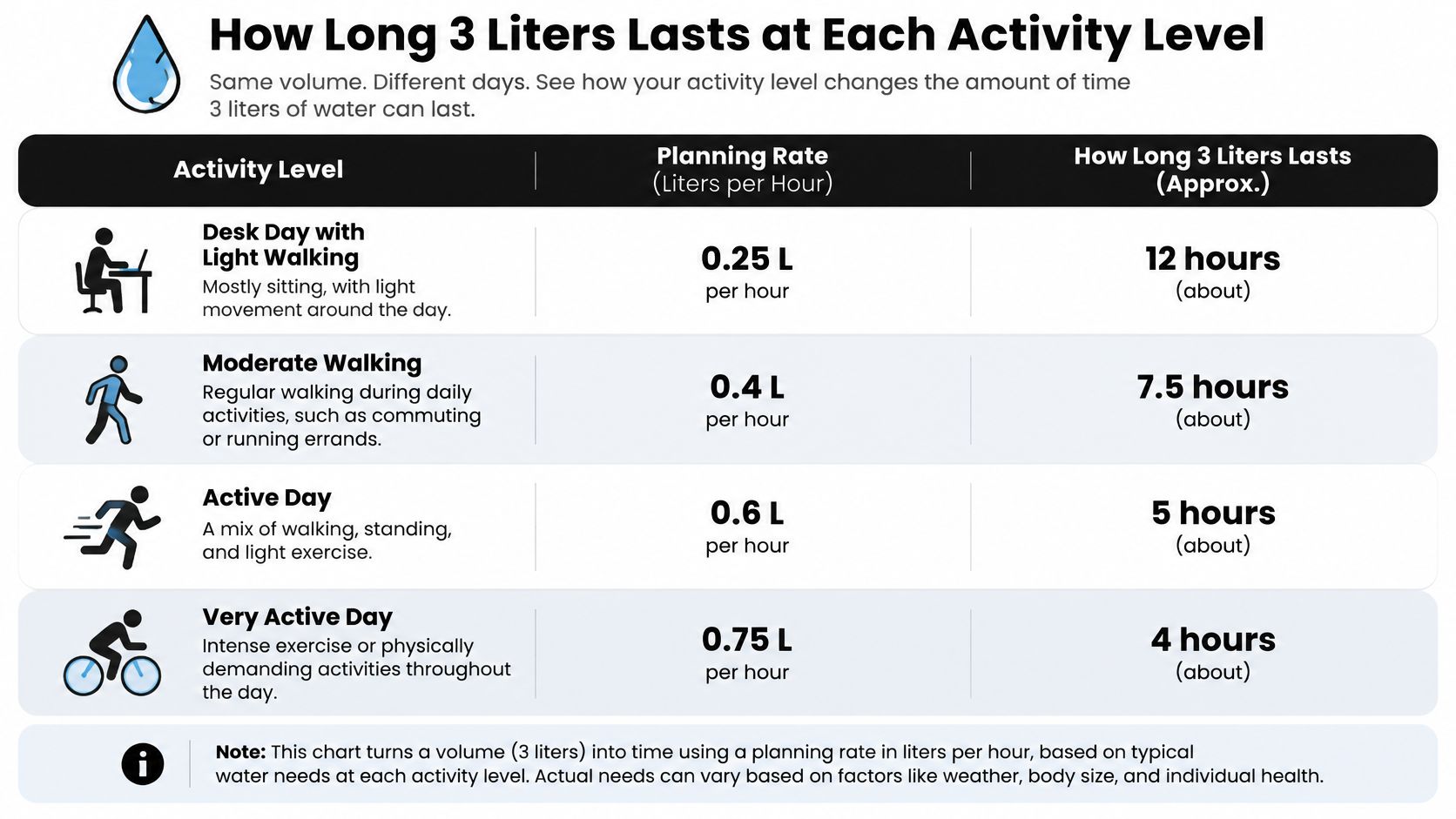
How Long 3 Liters Lasts at Each Activity Level
| Activity | Planning rate (L per hour) | Hours 3 liters lasts | Typical example |
|---|---|---|---|
| Desk day, light walking | 0.25 | About 12 | Office workday with commute |
| Moderate walking, mild weather | 0.5 | About 6 | City sightseeing day |
| Hot-weather day hike | 0.75 | About 4 | Summer trail hike |
| Hard exertion in heat | 1.0 | About 3 | Summit push or heavy labor outdoors |
These are hypothetical budgeting scenarios, not measured requirements or recommended drinking rates. The arithmetic answers how long a container lasts if you use water at the listed rate. It doesn't establish how quickly your body needs you to drink.
The visual below uses alternative example rates for some activity labels. Treat both as volume-to-time illustrations, not interchangeable physiological categories.
Turn your route into a water budget
Say you're planning a six-hour summit day in 30°C heat and use 0.75 L per hour as a hypothetical planning assumption. That produces a 4.5-liter budget, so a 3-liter supply would last about four hours at that assumed rate. You'd need additional carrying capacity, a verified refill, or a shorter route.
Don't assume a stream shown on a mapping app will be flowing or suitable to drink untreated. Check current conditions, seasonal access, and treatment requirements before counting it as a refill.
Heat, altitude, exertion, and pack weight deserve attention when choosing your planning assumption. For a running-specific approach, use HYDAWAY's guide to staying hydrated while running alongside your route and weather assessment.
Separate trail planning from survival planning
The World Health Organization's emergency water guidance estimates 2.5–3 liters per person per day for drinking and food-related survival needs, depending on climate and individual physiology. That isn't a complete household allocation for cooking, washing, and hygiene.
A survival allowance is not a comfortable hiking allowance.
To refine your own budget, weigh yourself before and after a one-hour walk in comparable conditions, wearing similarly dry clothing. Account for drinks consumed and urine passed; body-weight change alone isn't a clean sweat measurement. Use the result as a rough planning check, not a reason to force fluid intake.
What 3 Liters Covers in a Day and What It Does Not
Three liters of plain water isn't a universal daily target. A bottle counter can track what you drink, but it can't tell you everything your body needs or everything your meals already supply.
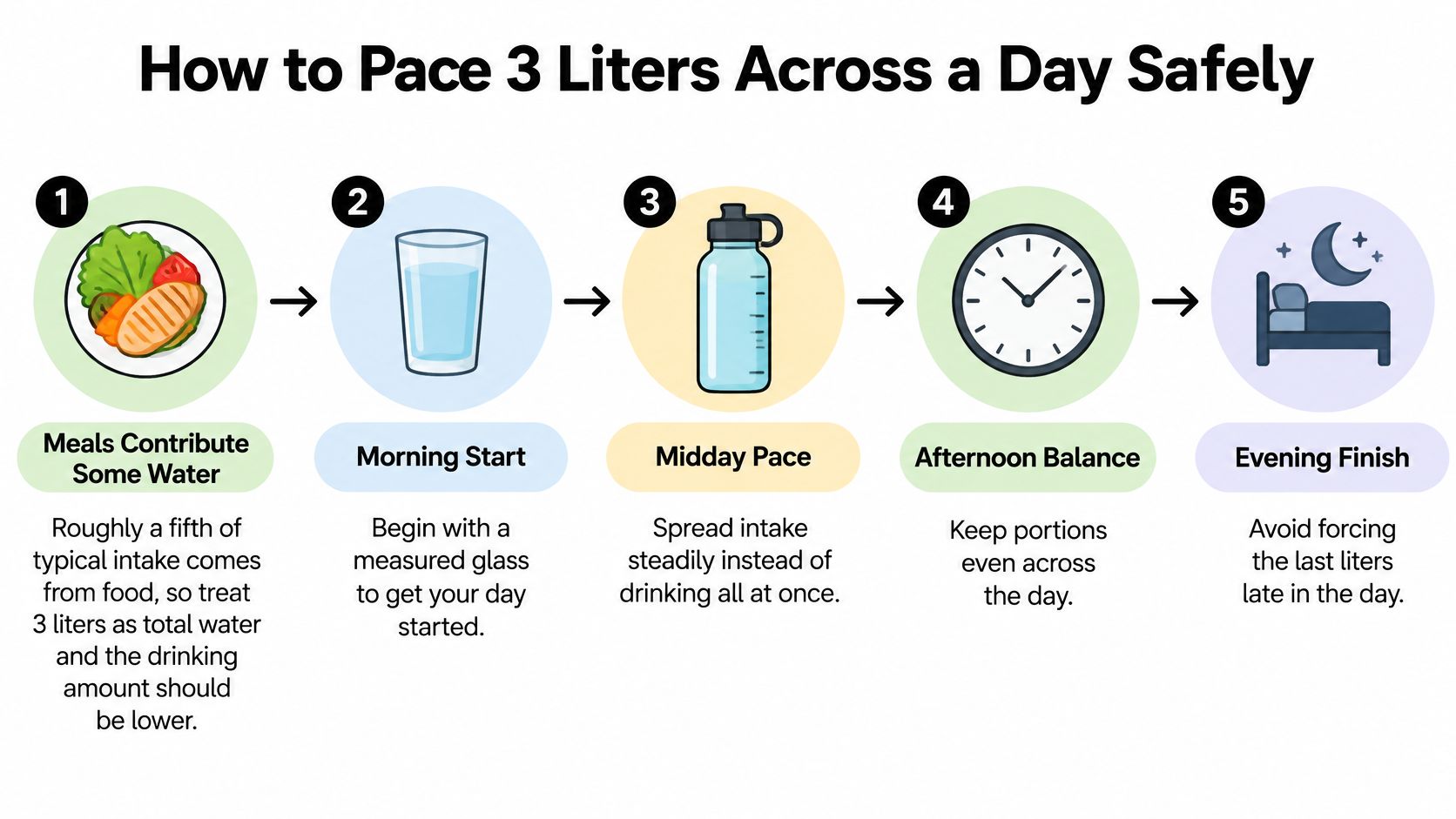
The Mayo Clinic's water guidance cites National Academies reference amounts of approximately 2.7 liters daily for women and 3.7 liters for men, counting beverages and food; about 20% of typical intake comes from food. On that basis, a hypothetical 3-liter total-water intake might include roughly 2.4 liters from beverages, with the rest coming from meals.
Same number, different days
| Reader | What belongs in the plan |
|---|---|
| Office worker on a mild day | Coffee, tea, other drinks, and water-rich meals all contribute. There's no reason to ignore them and restart the count with plain water. |
| Summer hiker | Drinking-water access matters throughout the route. Food moisture doesn't replace a suitable carried supply or a dependable refill plan. |
For the office worker, a refillable bottle beside the keyboard makes drinks accessible without turning hydration into a challenge. Soup at lunch and fruit with a snack also contribute water, even though they don't appear on the bottle's markings.
For the hiker, the important decisions happen before leaving the trailhead. Check exposed terrain, likely effort, shade, and the distance between usable water sources. A cool morning departure doesn't guarantee cool conditions on the return.
Adjust to the person and the conditions
Body size, age, pregnancy, physical activity, illness, and climate can change requirements. Fever, vomiting, and diarrhea also deserve attention because they can increase fluid losses.
- Use thirst as an input: Don't ignore it because a tracking app says you've finished.
- Watch urine color in context: It can offer a rough check, but it isn't a diagnosis.
- Notice how you feel: Feeling unwell during heat or exertion calls for reassessment, not just another bottle.
People with kidney, heart, or endocrine conditions, or prescribed fluid restrictions, should follow individualized medical advice instead of adopting a general volume target.
How to Pace 3 Liters Across a Day Safely
A useful hydration routine makes drinks available without making finishing a container compulsory. The National Academies' water guidance emphasizes that requirements vary with activity and environmental conditions, so a schedule should remain adjustable.
Build a flexible routine
The following quantities are an illustrative routine for organizing drink breaks, not a prescription. Scale portions down or skip them when they don't match thirst, meals, conditions, or medical guidance.
- Count meals and other drinks first. If you're thinking in terms of total water, don't add a full plain-water target on top of everything else automatically.
- Start with a measured glass after waking. About 500 mL within the first hour is an example portion, not something to finish quickly or force.
- Pair drinking with breaks. An example rhythm is about 250 mL every 60–90 minutes, adjusted to your needs rather than followed by the clock alone.
- For a long climb or workout, make water accessible beforehand and afterward. You might allocate 500 mL before and 500 mL during the hour after as planning portions, but don't add them automatically to an already sufficient intake.
- Avoid an evening catch-up. Place your final planned refill before dinner if that suits your routine, while still responding to thirst later.
- Reassess before the next portion. Consider thirst, recent sweating, meals, bathroom frequency, and how you feel rather than treating an unfinished bottle as a failure.
Drinking large volumes quickly can dilute blood sodium, causing dilutional hyponatremia. It can also mean frequent bathroom trips. Steady, responsive drinking is preferable to trying to finish a missed daily allocation in a single push.
Don't confuse electrolytes with permission to overdrink
During sustained heavy sweating, replacing sodium through appropriate food or electrolyte drinks may matter. Electrolytes don't make excessive water consumption safe, and they don't remove the need to adjust intake.
HYDAWAY's explanation of how much hydration is too much offers additional context for avoiding a bottle-count-at-all-costs approach.
For tracking arithmetic, six fills of about 500 mL equal 3 liters. A roughly 17-ounce bottle can make that count straightforward, but count the initial fill correctly: six fills means the first fill plus subsequent refills, not six additional refills.
Choose Your Containers and Bottle Count
Hours × planning rate = water budget. Water budget ÷ container capacity = fills required. Round up when deciding how much capacity you need without a refill.
Using a hypothetical six-hour outing at 0.75 L per hour gives 4.5 liters, equivalent to nine 500 mL fills. That doesn't necessarily mean packing nine bottles. It means either carrying the entire budget or identifying dependable places to replenish a smaller container set.
Containers needed to carry 3 liters
| Container | Capacity | Units to carry 3 L | Packing note |
|---|---|---|---|
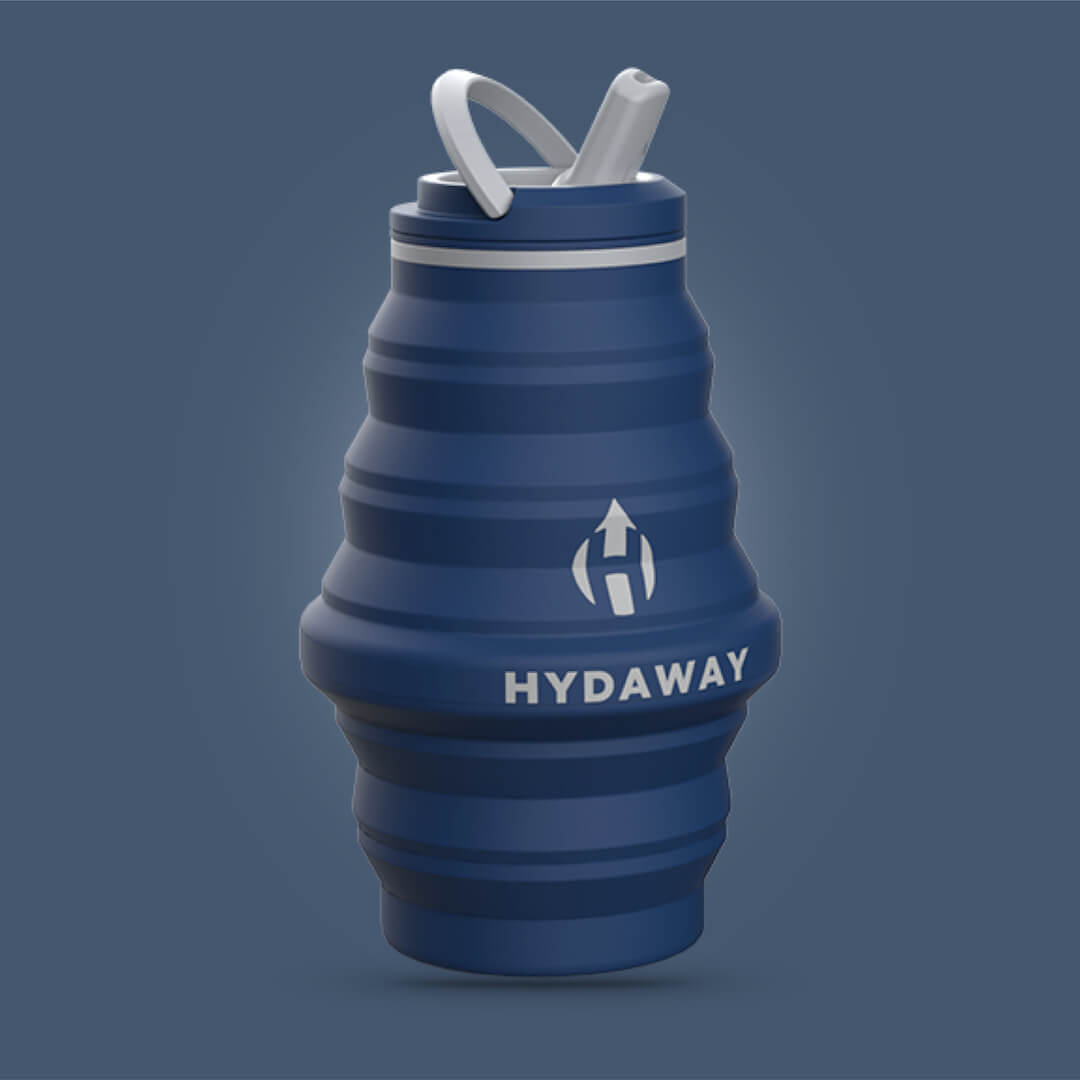
| HYDAWAY 17 oz collapsible bottle | About 503 mL | 6 bottles, approximately 3.0 L | Folds flat when empty |
| HYDAWAY 25 oz collapsible bottle | About 739 mL | 4 full bottles plus a small top-up | Folds flat when empty |
| Rigid 1 L bottle | 1 L | 3 bottles | Holds shape, adds weight when empty |
| 3 L hydration bladder | 3 L | 1 bladder | Needs a pack sleeve and hose route |
| Standard 500 mL bottle | 500 mL | 6 bottles | Simple and widely available |
The capacities shown for ounce-labeled bottles are approximate US fluid-ounce conversions. Four 25-ounce bottles fall slightly short of the target, so the top-up needs its own container rather than imaginary space inside already-full bottles.
Our HYDAWAY 17oz Collapsible Water Bottle costs $29.95 and collapses to a 1.5-inch profile. Alongside the larger option in the table, it suits a commuter who wants a bottle at the office but less bulk on the journey home. Our Hydration Travel Pack is TSA-approved; that doesn't exempt filled containers from airport liquid restrictions.
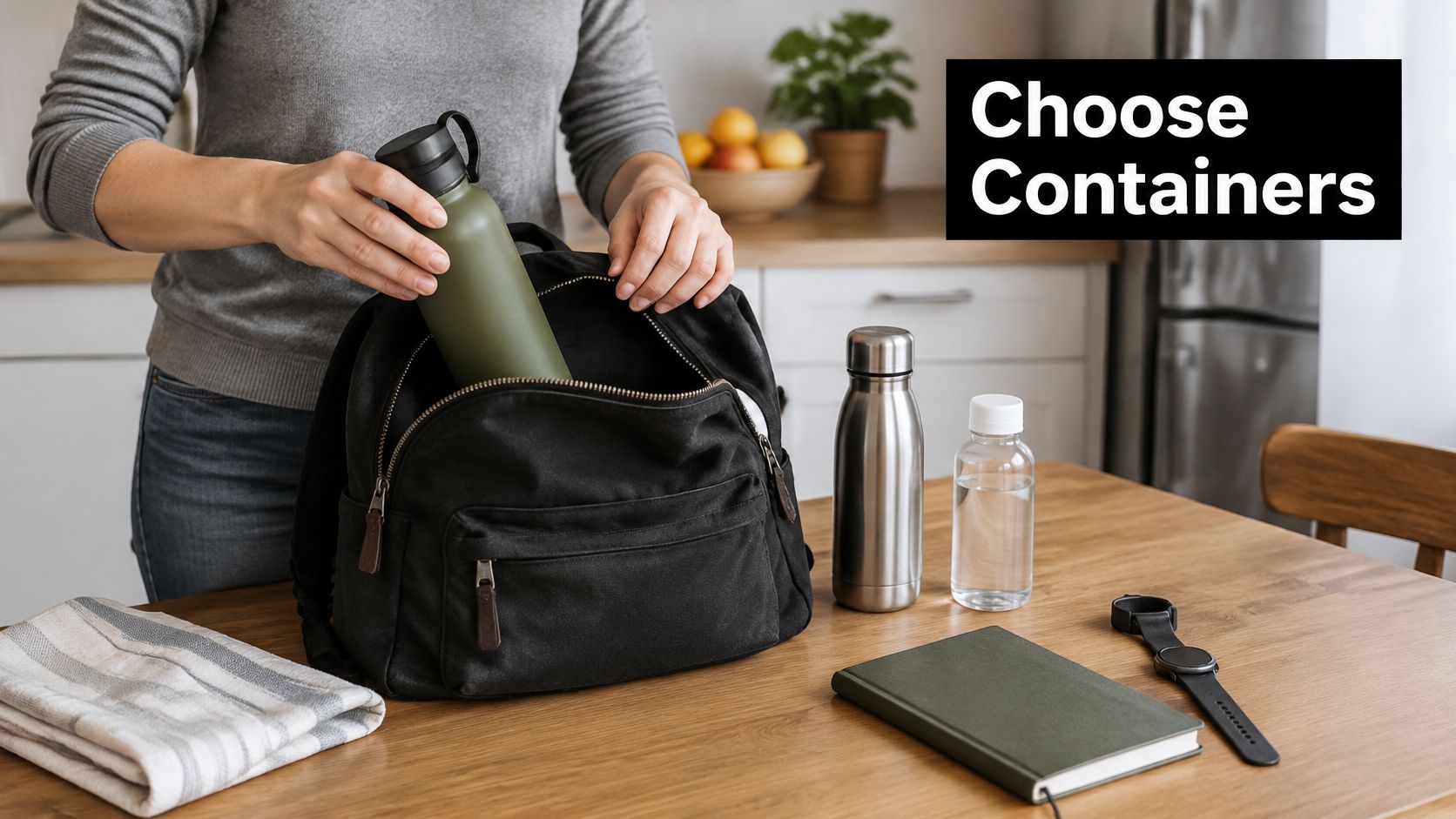
One large container or several smaller ones
A large bladder makes drinking convenient while walking and reduces the number of separate vessels to manage. The trade-off is concentrated risk: a leak can affect your whole supply, and checking the remaining volume may require opening your pack.
Smaller containers let you separate drinking water from a reserve and distribute bottles among accessible pockets. They also mean more lids to check and more pieces to clean. Collapsible containers save space after you empty them, not while carrying the same volume of water.
Choose empty-container convenience separately from full-load comfort. A bottle can pack beautifully when folded and still need a secure pocket when full.
For a carry-on trip with frequent safe refills, fewer containers may be sufficient. For a remote route without reliable water, empty packability shouldn't take priority over adequate capacity.
Run a packing test before departure
- Fill the actual set: Include the reserve you intend to carry for delays or unexpectedly demanding conditions.
- Weigh the complete pack: Water is only part of the load.
- Walk for twenty minutes: Treat this as a practical shakedown, checking bottle bounce, shoulder pressure, and whether you can drink without unpacking.
- Verify the refill plan: Confirm access, opening hours where relevant, and whether treatment is necessary.
Six small bottles can carry the target, but that isn't automatically the best purchase. Fewer larger containers may simplify handling; compare their actual empty weights rather than assuming larger means lighter.
Packing 3 Liters for Flights and Trails
At the airport
The Transportation Security Administration's permitted-items guidance allows empty water bottles through U.S. security, while filled bottles exceeding 3.4 ounces (100 milliliters) generally can't pass under standard liquid rules.
- Pack empty: Put the bottle where you can reach it if screening staff need to inspect it.
- Refill after screening: Check the airport's current facilities rather than assuming a fountain will be available near your gate.
- Keep it accessible: Place it upright and within reach during the journey, following crew instructions about stowing belongings.
Say you're a digital nomad leaving for a working holiday. Keep your drinking bottle in the carry-on's accessible pocket and a spare collapsible container in your day pack. Fill what you need after screening, then reassess before the walk or transit ride to your accommodation.
On the trail
Arrange the supply around balance and access, not just empty space. Keep heavier containers near the back panel and secure them so they don't shift. Put a drinking bottle in a reachable front or hip pocket if your pack supports it.
- Separate the reserve: Don't bury every container beneath clothing and food.
- Plan treatment: The Ring Hot Water camping guide provides useful context for thinking through water purification while camping.
- Organize camp water separately: Use HYDAWAY's camping water-storage guide when your trip also requires water for meals and washing.
For travel today, check current screening instructions and refill facilities shortly before departure. Pack the empty bottle first, refill after security, and fill the trail containers when you're ready to carry their weight.
HYDAWAY offers collapsible bottles and travel gear that save space between refills, whether you're commuting, flying, or heading for a trailhead. Visit HYDAWAY to choose a bottle size that fits your water budget, available refill points, and pack pockets.