Difference Between Single Use Plastic and Reusable Plastic

Reusable packaging can sharply reduce the climate impact of single-use packaging, but the savings only hold while the item keeps getting used. The Difference Between Single Use Plastic and Reusable Plastic is the count of completed uses: whether one durable bottle replaces enough disposables to repay its larger upfront footprint.
That footprint is real: more polymer, more manufacturing energy on day one. Routine decides whether it gets repaid: refills, washing, carrying. Stop short, and the greener option on paper loses in practice.
Single-Use and Reusable Plastic Side by Side
Think of a single-use item as a hotel night. You pay for one brief stay, leave in the morning, and repeat the full cycle next time. A reusable item is closer to a home you furnish once and live in for years. The upfront cost and material are higher, but every additional night spreads that initial investment further.
That timing is the whole comparison. A bottle built for one drink consumes polymer, energy, transport and disposal capacity for one service. A bottle built for hundreds of refills consumes more polymer at the start, then asks only for water, washing and care between services. If you abandon it in a drawer, you've bought the furnished home and kept paying for hotel nights too.
Single-Use vs Reusable Plastic at a Glance
| Factor | Single-use plastic | Reusable plastic |
|---|---|---|
| Designed number of uses | One | Many repeated uses, often tens to hundreds |
| Plastic per use | Low per item, but bought again and again | Higher per item, spread across uses |
| Typical service life | Minutes to one trip | Months to years with care |
| Share of plastic waste | Packaging and products under five years make up almost two-thirds of global plastic waste | Fewer replacement items enter the waste stream when used repeatedly |
| End-of-life route | Collection, sorting and processing, or landfill and incineration | Cleaning and repair first, then eventual disposal |
| Hygiene demands | Sealed at manufacture, no cleaning needed | Washing, drying and seal care required |
| Cost pattern | Low price, repeated purchases | Higher upfront cost, lower cost per use |
| Main lever on outcome | Local collection and recycling system | User habits, durability and maintenance |
Why Short Service Lives Dominate Waste
Short-lived products matter because they multiply manufacturing and disposal events. According to the OECD Global Plastics Outlook, plastic production increased from 2 million tonnes in 1950 to 460 million tonnes in 2019, a 230-fold increase, while annual plastic waste rose from 156 million tonnes in 2000 to 353 million tonnes in 2019.
The same OECD estimates put packaging at 40% of plastic waste, consumer products at 12%, and textiles at 11%. Packaging and other products with lifespans of less than five years account for almost two-thirds of global plastic waste. A commuter who buys bottled water at the station five days a week isn't making one small packaging decision. She's creating a recurring stream of bottles, caps, labels, transport and collection decisions.
I would judge any reusable by one counterpoint before anything else. It contains more plastic than one disposable item, so it only wins after it has prevented enough disposable items from being made. Washing and transport add impacts too. The advantage comes from avoiding many future production cycles, not from owning a thicker bottle.
Ask one question before you buy. How many completed uses will this item realistically get in your actual routine?
For a traveler, that might mean a bottle that stays in a personal item through the airport, fills after security, then works in a hotel, on a hike and during sightseeing. For a parent, it might mean a tumbler that goes to school events, sports practice and theme parks. Packable, easy-to-clean gear earns more completed uses because you don't leave it behind when bag space gets tight.
How Many Uses Make Reusable Plastic Greener
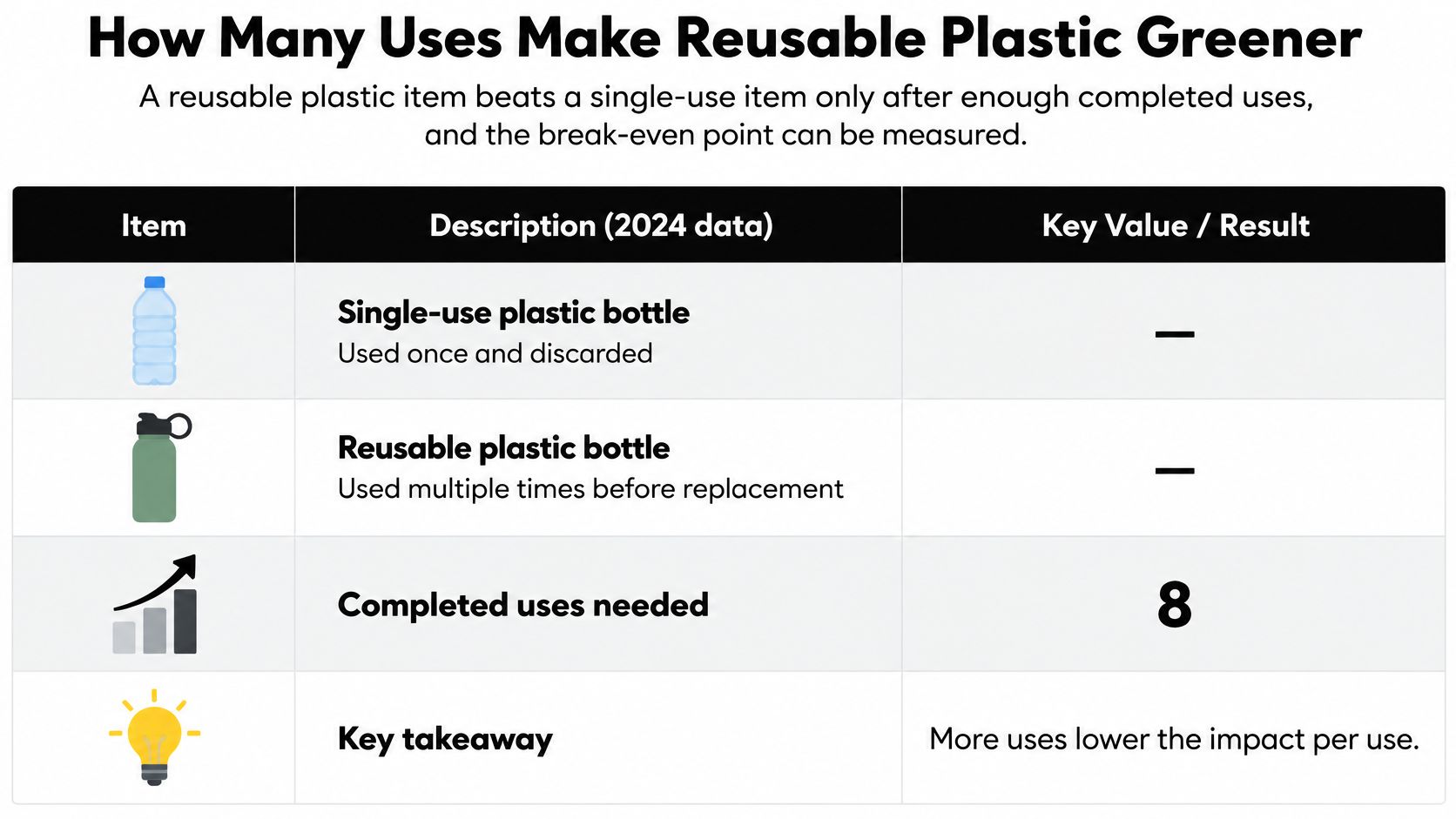
A reusable plastic item beats a single-use item only after enough completed uses, and that break-even point can be measured. The 2024 life-cycle assessment of reusable takeaway containers catalogued in the FAO AGRIS record for the 2024 assessment found that a reusable container required at least six uses to outperform a single-use container on global-warming potential under its centralised collection-and-washing scenario.
That threshold is a benchmark rather than a universal guarantee for every bottle, bowl or coffee cup. Its value is that it counts both manufacturing and the operational burden of returning and washing containers. Return-system efficiency shifted the result materially, which shows logistics can weigh almost as heavily as the container itself.
Reusable vs Single-Use Emissions by Number of Uses
| Completed uses | Reusable (kg CO2e per use) | Single-use (kg CO2e per use) | Result |
|---|---|---|---|
| Fewer than 6 | Above 0.020 | 0.020 | Single-use has lower global-warming potential |
| 6 | 0.020 | 0.020 | Break-even point |
| 10 | Below 0.020 | 0.020 | Reusable ahead |
| 100 | Well below 0.020 | 0.020 | Reusable far ahead |
Read the progression carefully. The reusable column keeps falling as completed uses climb, while the single-use column stays flat because each disposable carries one full production cycle. Nothing about the container changes between rows. The owner spreads one production impact across more and more services.
Estimate Your Own Threshold
Use the break-even number as a planning tool. Divide six uses by your completed uses per week. A bottle filled four times a week reaches six in about 1.5 weeks. A container used once a week needs six weeks. A festival cup used twice a year needs three years to clear the same benchmark, and it may be lost or replaced first.
Then adjust the estimate with the conditions around you:
- Trip frequency: Daily commuting builds use counts faster than one annual vacation.
- Water access: Easy refills at work, campgrounds, hotels and airports encourage another use.
- Washing method: Full dishwasher loads and efficient hand washing protect the margin better than running hot water for one item.
- Product lifespan: A cracked lid or failed seal can end the count before payback.
- Purchases avoided: The benefit is strongest when each refill replaces a bottled drink or disposable food container you otherwise would have bought.
Packability counts as an environmental feature in its own right. A bottle that fits a crowded carry-on or hiking pack gets carried through more airports and trailheads, while a bulky bottle left at home earns no credit for its potential. Readers comparing hydration choices can apply the same use-count logic alongside this guide to the environmental impact of reusable water bottles.
My judgement is simple. A durable reusable used consistently can move ahead quickly. An inconvenient reusable left at home delivers almost no environmental benefit, no matter how virtuous the purchase felt.
Where the Impact Moves Across the Product Lifecycle
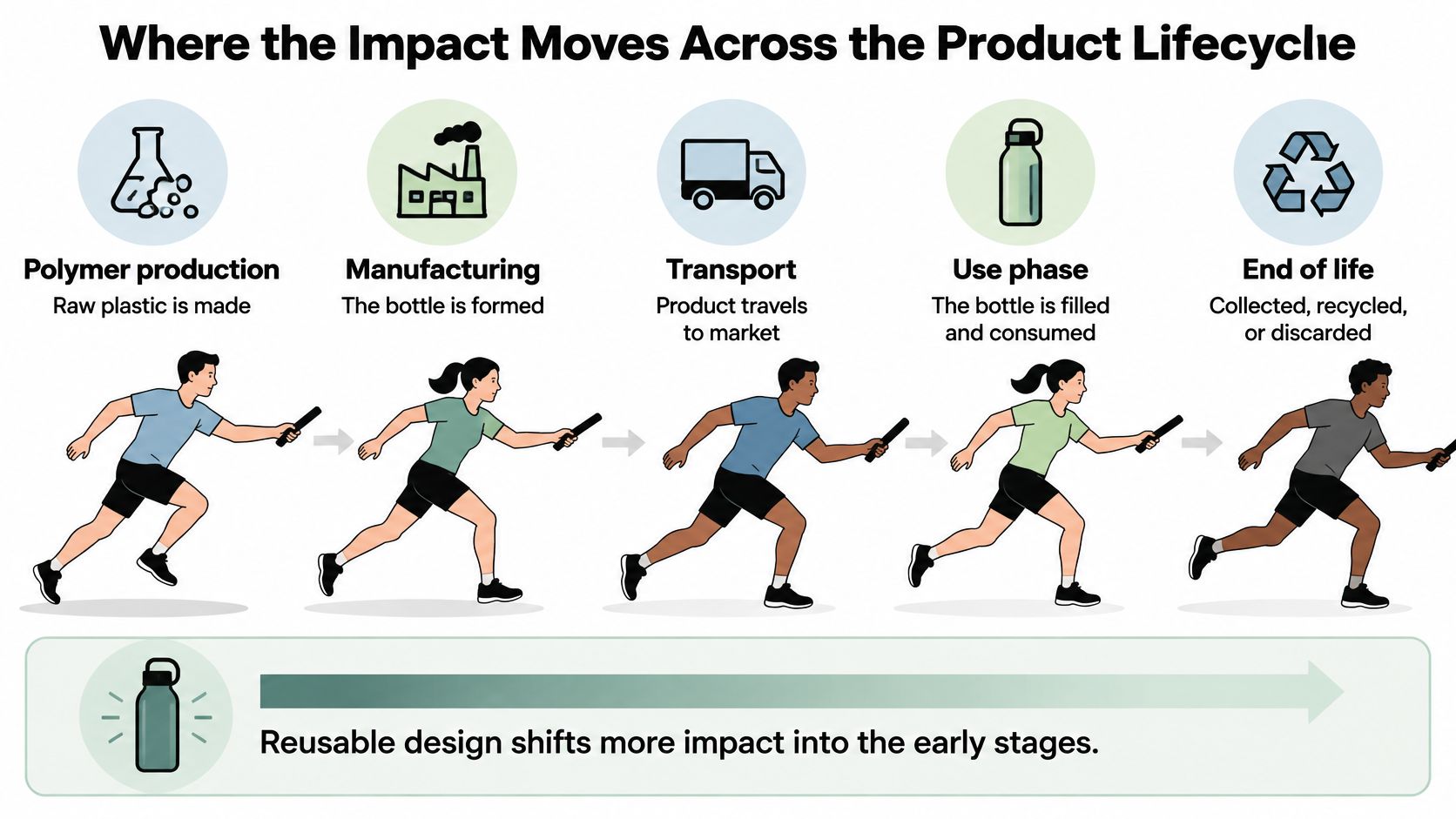
Impact behaves like a relay race. Polymer production passes the baton to manufacturing, manufacturing passes it to transport, transport passes it to use and cleaning, and the final runner carries it to disposal or recycling. Reusable design moves more of the heavy lifting to the first leg.
A single-use bottle repeats the entire race for every drink. A reusable bottle runs the production leg once, then repeats a shorter loop of filling, carrying, washing and drying. Its initial production burden is usually larger because it needs more material and stronger construction. That burden becomes worthwhile only when repeated service displaces enough new bottles.
Mass and Service Life Do the Heavy Work
The South African life-cycle assessment comparing single-use and reusable PET bottles evaluated 13 impact categories and found the reusable bottle had lower impacts in every category. The dominant variable was the mass of PET required to deliver the same volume of water.
Two design priorities follow directly. First, keep the reusable product lightweight without making it fragile. Extra material raises the starting burden and any transport burden that follows. Second, maximize service life. A lightweight bottle that survives years of commuting spreads its manufacturing impact thinly. A fashionable bottle replaced every season restarts the race and wastes the supposed advantage.
Where Your Choices Move the Needle
You control the middle stages more than the factory gate. Wash containers with a full dishwasher load where suitable, choose cooler efficient cycles, and don't run a sink of hot water for one cup after every sip. Carry the same item throughout a trip instead of buying a disposable at each stop. Repair or replace a gasket when that keeps the main body in service.
End of life still matters. Eventually every reusable becomes waste, and a product used hundreds of times needs responsible disposal through an accepted local route. That final impact is shared across its whole service history. For a bottle replaced after a handful of uses, disposal arrives before the production debt has been repaid.
Practical rule: Buy the lightest durable design you'll actually carry, then protect its lifespan.
Ask which stage dominates your own footprint. If you rarely use the item, production is the problem. If you use it daily but wash it wastefully, cleaning deserves attention. If you discard it while it's still functional, disposal and replacement erase progress. The best answer is the stage you can change without making the routine so annoying that you quit.
Why Recycling Alone Cannot Solve the Plastic Problem
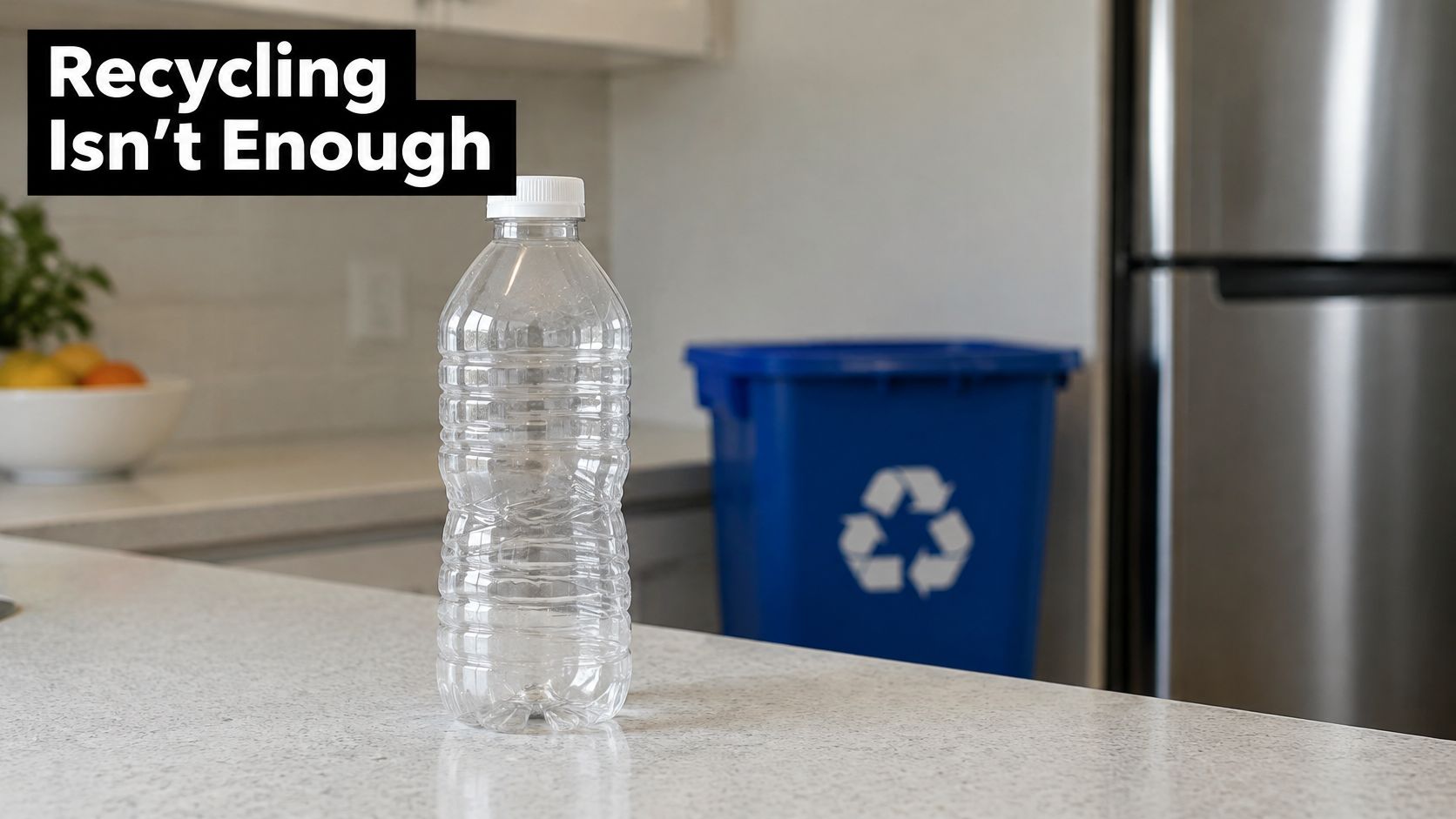
Plastic doesn't become recycled because you placed it near a blue bin. It has to enter the right stream, survive collection and sorting, and reach a processor that can turn it into usable material. Break any link in that chain and the item can end up landfilled or combusted for energy recovery.
The image below captures the everyday assumption behind that chain.
Collection Is a System Target
Under the European Union Single-Use Plastics Directive guidance, for plastic beverage bottles up to three litres, EU member states must achieve separate collection equal to 77% of bottles placed on the market by 2025, increasing to 90% by 2029, calculated by weight. The 2025 milestone has passed, so current national reporting matters. The 2029 target remains the benchmark ahead.
Those percentages describe an entire market, not the fate of your bottle in Lisbon, Berlin or a rural service station. Deposit-refund systems and extended producer-responsibility schemes are tools governments use to improve capture. They still depend on local infrastructure, clear rules and people returning containers to the right place.
Travel exposes the weakness quickly. Collection rules change across borders, bins disappear at trailheads, and a bottle bought during a short layover may never reach an efficient sorting system. A collapsible bottle packed flat in a day bag and expanded after airport security avoids that dependency for drink after drink. It also works during sightseeing, hiking, commuting and hotel stays, provided you refill from a safe source.
The same system-first thinking applies at home. If single-serve coffee is part of your routine, reusable K-Cup alternatives explained by PureHQ offer a useful resource for avoiding a recurring stream of small disposable pods instead of hoping every pod is processed correctly.
Watch how reuse fits a travel routine when recycling access is uncertain.
Check local rules before relying on a bin, especially abroad. Recycle what you must discard, return deposit containers where required, and keep caps with bottles when local instructions ask for that. I would treat recycling as the backup system. Prevention through repeated use is the plan.
Hygiene, Washing and Safety Questions Answered
A reusable container isn't automatically dirty, and a single-use container isn't hygienic in every circumstance once opened and handled. The honest difference is control. Single-use packaging arrives sealed, so the manufacturer controls its starting condition. With a reusable, your washing, drying and storage habits control what happens next.
A 2021 peer-reviewed assessment of reusable polypropylene produce crates modelled 150 rotations and reported a higher cross-contamination risk for polypropylene than for the compared cardboard and wood-based alternatives, although the result depends on cleaning and handling conditions. Produce crates aren't personal water bottles, but the lesson transfers. Reuse systems need actual cleaning discipline, not hopeful rinsing.
A Routine That Works at Home and on the Road
Hygiene depends on design, cleaning frequency, drying, your behavior and the condition of seals and crevices. Build a routine simple enough to repeat after a red-eye flight or a dusty campsite dinner:
- Rinse promptly: Empty leftovers and rinse after use so sugars, milk and food oils don't sit in seams.
- Wash thoroughly: Use warm soapy water and a bottle brush, or the dishwasher when the product is dishwasher safe.
- Dry fully: Leave the item open and upside down until the interior and lid are dry before sealing it.
- Inspect seals weekly: Remove gaskets where the design allows, wash beneath them, and check for cracks, warping or trapped residue.
- Separate risky foods: Keep a container used for raw meat away from ready-to-eat food until it has been washed properly.
- Retire damaged gear: Replace an item that is cracked, badly scratched, leaking or permanently odorous.
Low-water travel calls for planning rather than skipping hygiene. Rinse with a small amount of safe water after a meal, then do a full wash when you reach a hotel, campground sink or van kitchen. Dry gear on a clean towel or hang it open from a pack strap where air can circulate. Don't seal a damp bottle inside luggage for two days and expect it to smell neutral.
Material claims deserve the same skepticism as environmental claims. Check the material grade, care instructions and test records, and treat labels such as BPA-free or PFAS-free as statements to verify rather than blanket safety guarantees. Readers sorting through material choices can compare those details with this overview of safe plastics for food storage.
Persistent odor, visible damage and a seal that no longer closes tightly are practical replacement signals. A container you can't clean confidently won't get used, and an unused reusable fails both the hygiene test and the environmental test.
Cost, Habits and Your First Reusable Switch
Cost per use turns a vague sustainability preference into arithmetic. Divide the purchase price by completed uses. In an illustrative example, a $30 bottle used 200 times costs 15 cents per use. Buying 200 bottled waters at $2 each costs $400. Those aren't universal prices, so insert your local bottled-water price, cafe charge or theme-park drink cost and your realistic use count.
The upfront price is the barrier because it arrives all at once. Disposable purchases hide their total in small transactions at airports, gas stations, offices and stadium counters. A commuter who refills at work can recover a bottle's price quickly. A household that already drinks tap water from glasses at home gains less because the reusable replaces fewer purchases. I would start where spending repeats most often, not where a new product looks most appealing.
Better Choice by Everyday Situation
| Situation | Better choice | Reason |
|---|---|---|
| Daily commute with water | Reusable | Used most days, so the use count climbs fast |
| Theme park day | Reusable | Avoids repeated bottle and snack purchases through the day |
| Long-haul flight | Reusable if carried every trip | Payback depends on trip frequency |
| Camping or van life | Reusable | Refill access is limited and packability matters |
| One-off restaurant takeout | Reusable only if carried | Low use count if left at home |
| Occasional use at home | Single-use may be lower impact | Few completed uses, so break-even is rarely reached |
A borderline case can move. Say you fly long-haul twice a year and would use a bottle only in airports. Add hotel refills, conference days, train rides and hikes during those trips, and the annual count rises. Keep it by your keys during normal weeks and it becomes a commute bottle too. The product didn't change. Your default routine did.
Make Carrying the Default
Habits decide whether cost and break-even calculations become real. Put the clean bottle beside your keys, not in a high cabinet. Pack it the night before a trip. Check refill locations at the airport, office, gym or national park before you leave. After washing, return it to the same bag pocket so you don't conduct a kitchen search while a rideshare waits outside.
Families save differently. A parent entering a theme park with refillable tumblers and a collapsible bowl for snacks can reduce several impulse purchases in one day. A digital nomad benefits from gear that disappears into a personal item between cities. A van-lifer values the same packability because cabinet space is permanent rent. The useful feature is the one that removes friction from your next use.
A reusable earns its footprint through boring repetition.
Your First Switch in Five Steps
- Pick your most frequent disposable. Choose the bottled water, coffee cup or takeout container you replace most often.
- Estimate realistic use. Count completed uses per week and multiply across the year, then compare that number with the break-even method.
- Choose for carry and cleaning. Select a lightweight, leak-resistant item that's easy to wash and, where that suits your routine, dishwasher safe.
- Start clean. Rinse, wash and dry it fully before the first outing, then keep that routine after each use.
- Track 30 days. Log every completed use, and add a second reusable category only after the first has become automatic.
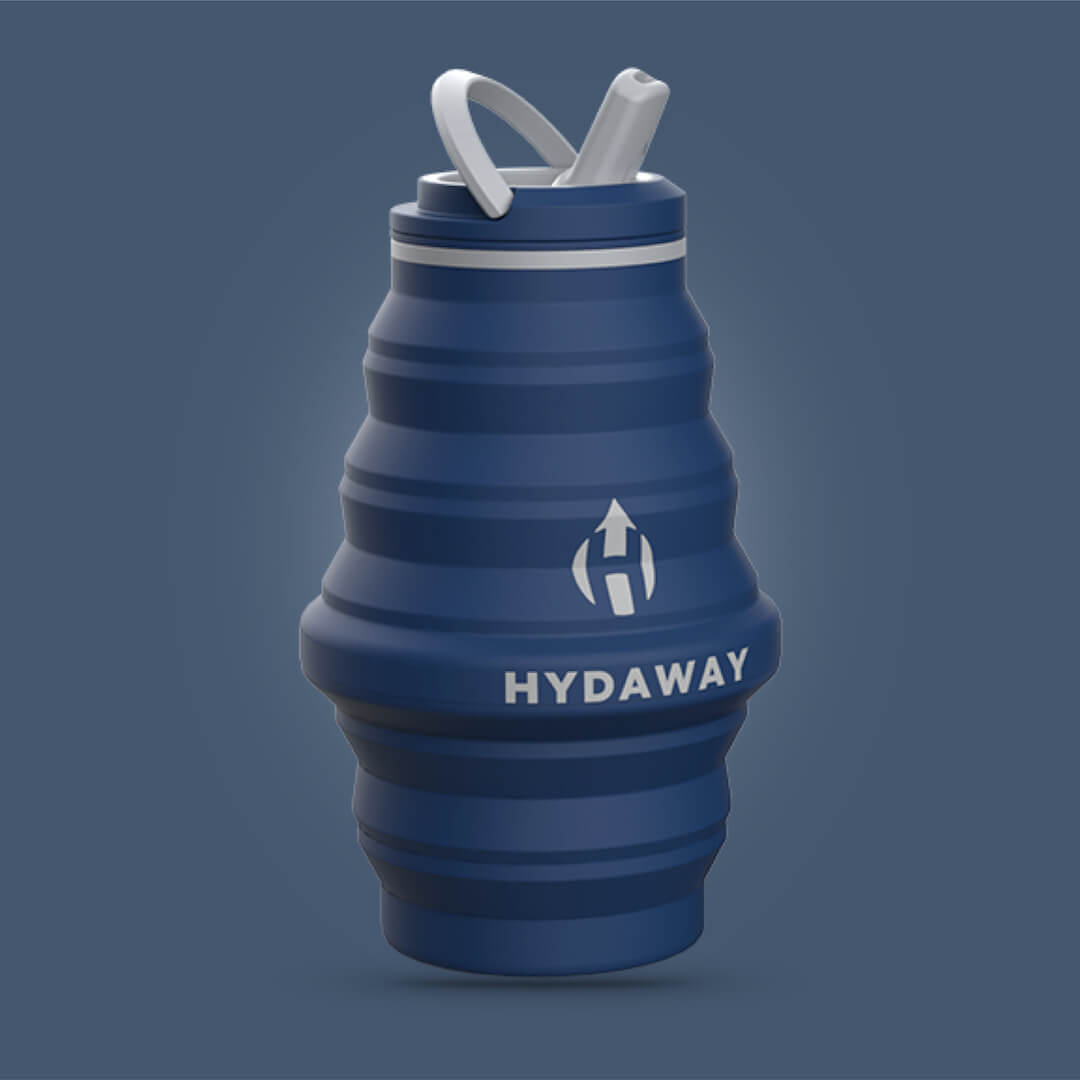
Collapsible silicone plays a key role in the comparison. Silicone isn't plastic, so consider it a reusable alternative rather than another type of reusable plastic. HYDAWAY's 17oz collapsible water bottle collapses from a 17oz capacity to a 1.5 inch profile, is made from resilient silicone, and is suitable for the dishwasher. All HYDAWAY products are 3rd-party tested and free from BPA, phthalates, PFAS and other plastic pollutants, as stated in the product documentation. The environmental point is behavioral. A bottle that fits a jacket pocket, daypack or crowded carry-on is more likely to be present for the refill that replaces a purchase.
Use that test with any brand. Will it fit your bag, survive being dropped, seal in a tote, clean without special tools and suit the drinks you buy? If the answer is no, a cheaper or prettier alternative may become expensive clutter. If the answer is yes, log the first ten uses and watch the cost per use fall.
Readers ready to extend the same habit beyond bottles can work through practical ways to reduce single-use plastic one recurring purchase at a time. Don't replace every disposable in your kitchen this week. Choose one item, carry it until the habit feels ordinary, and let the completed-use count prove whether the switch worked.
Choose the one disposable you buy most often, replace it with a reusable you'll really carry, and log its first ten uses this week. HYDAWAY makes collapsible bottles, tumblers and bowls that pack small for travel, commuting, camping and family days out, so keeping one within reach is easier. Visit HYDAWAY to find the packable reusable that fits your routine and start building its use count.